
What Is Flux Remover and When Should You Use It in Electronics Cleaning?
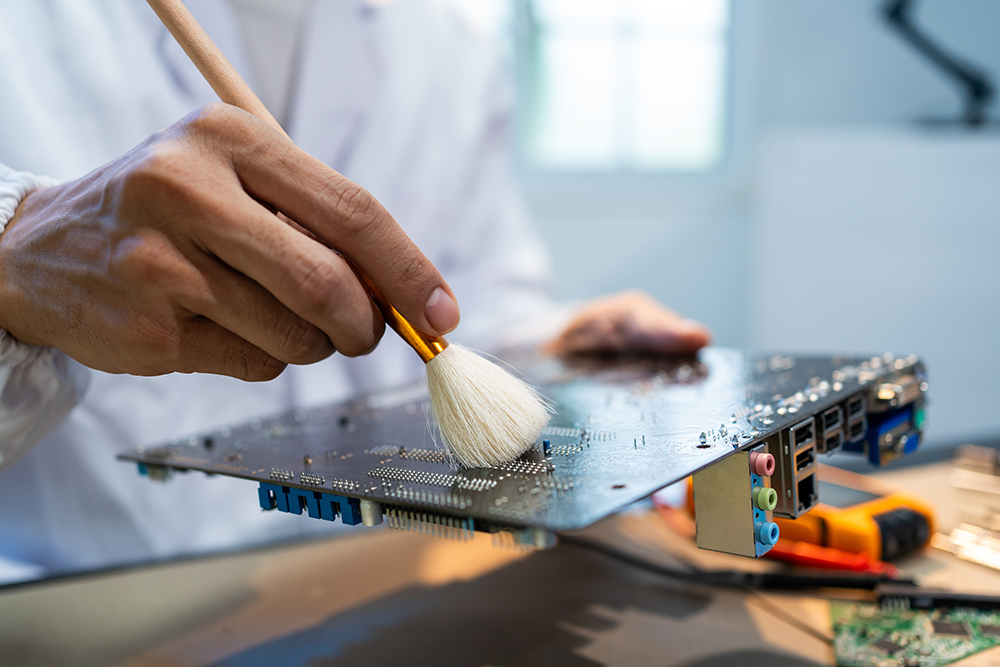
What Is Flux, and Why Does It Need to Come Off?
Before you can understand flux remover, it helps to understand why flux exists in the first place.
Flux is a chemical agent applied during the soldering process. It cleans oxidation from metal surfaces, improves solder flow, and helps create reliable, consistent solder joints. It does its job during soldering, but once the iron is down, it has no further purpose on the board.
What it leaves behind, however, does have consequences. Solder flux residue attracts moisture. Moisture leads to corrosion. Corrosion leads to current leakage, signal interference, and shortened component life. On a PCB running in a production environment, that kind of failure is not a minor inconvenience. It is a reliability problem that affects output, quality, and rework costs.
Removing flux residue is not optional when you care about the long-term performance of your assemblies.
What Is a Flux Remover?
A flux remover is a specially formulated solvent cleaner designed to dissolve and lift rosin-based solder flux from electronic components and circuit boards without damaging the materials underneath.
Unlike general-purpose cleaners or broad-spectrum degreasers, a flux remover is engineered for the precision demands of electronics cleaning. The right formulation:
- Dissolves rosin flux quickly and completely
- Leaves no residue behind after evaporation
- Is compatible with solvent-resistant components including PCBs, connectors, and relays
- Evaporates fast enough to support efficient production and rework workflows
Stoner Critical Cleaning's Multi-Purpose Flux Remover does exactly that. Its high-pressure aerosol stream flushes away flux residue and solder balls from close-tolerance SMT components, giving repairs and assemblies a factory-clean finish. It is non-flammable, leaves no residue, and is rated for use on solvent-resistant boards, components, connectors, and relays.
When Should You Use a Flux Remover?
This is where a lot of teams run into trouble. Not every cleaning task calls for a flux remover, but skipping it in the right situations creates problems that cost far more to fix later.
1. After any soldering or rework operation
Any time a technician completes a soldering job, flux residue is present. Whether you are running a full production line or doing bench repair on a single board, cleaning that residue before the assembly moves forward is standard practice in quality-driven facilities.
2. When your process requires residue-free results
If your assemblies go through functional testing, inspection, or conformal coating after production, flux residue left on the board can interfere with test results, obscure solder joint inspection, and affect coating adhesion. A fast-evaporating, residue-free cleaner ensures the board is ready for the next step.
3. To flush solder balls from reflow repairs
During reflow solder repairs, small solder balls can scatter across the board surface. A high-pressure flux remover stream physically dislodges and flushes those particles away, reducing the risk of shorts and contamination before the board moves down the line.
4. As part of a standardized PCB cleaning protocol
If your team runs multiple stations handling production, rework, and maintenance repair, standardizing on a reliable flux remover delivers consistent cleaning results across every technician and every shift.
When Should You Not Use a Flux Remover?
Flux remover is a targeted, high-strength cleaner. That strength is an asset in the right application, but it also means there are situations where it is not appropriate.
Do not use flux remover on:
- Energized equipment
- Polycarbonate, polystyrene, or ABS materials
- Display panels
- Solvent-sensitive coatings or materials
For those applications, a medium-duty electronics cleaner like Electro Klene is a better fit. Matching the cleaner to the substrate and contamination type protects your components and keeps your electronics assembly process running cleanly.
Flux Remover vs. Contact Cleaner: What Is the Difference?
You may already have a contact cleaner on your bench and wonder whether it covers the same ground. It does not, entirely.
Contact cleaners are formulated to remove dust, oil, grease, and dirt from connectors, relays, and electrical assemblies. They are effective for general contamination removal. But rosin-based solder flux is a different type of contaminant. It bonds to the board surface in a way that a general contact cleaner is not always strong enough to address.
Flux remover is purpose-built to break that bond. If your job involves post-solder cleanup on a printed circuit board, a dedicated flux remover is the right tool. If you are cleaning contacts and connectors without a soldering step involved, a contact cleaner may be sufficient.
Knowing which contaminant you are dealing with determines which product you reach for.
How to Apply Flux Remover Safely and Effectively
Using flux remover correctly protects both your components and your team.
- Work in a ventilated area. Even non-flammable formulations should be used with adequate airflow. Good ventilation keeps solvent concentrations at safe levels.
- Apply to de-energized equipment only. Always power down before cleaning. Allow the board to fully dry before re-energizing.
- Use the extension tube for precision. The aerosol nozzle on Stoner's Multi-Purpose Flux Remover includes an extension tube for targeted application, which helps you direct the stream exactly where flux residue is present without over-saturating the surrounding area.
- Follow up with a visual inspection. After the solvent evaporates, inspect the board for cleanliness before moving to the next stage of your process.
- Dispose of used materials appropriately. Follow your facility's solvent disposal procedures.
When these steps are part of your standard workflow, flux remover works the way it is designed to, quickly, cleanly, and without putting your components or your team at risk.
Ready to Clean Smarter and Reduce Rework?
Flux residue is invisible until it is not, and by the time the problem surfaces, the cost is already embedded in rework, warranty claims, or failed inspections.
Stoner Critical Cleaning's Multi-Purpose Flux Remover is factory-direct, non-flammable, residue-free, and in stock for same-day shipping on orders placed by 4 PM ET. Our chemists can help you confirm it is the right fit for your process. Contact us to get started.